The Civil War Library
Books
●
Articles
●
Journals
●
Period Newspapers
●
Memories and Letters
Books ● Articles ● Journals ● Period Newspapers ● Memories and Letters
Although The National Civil War Institute is not affiliated with the the following Organizations or Individuals, and although we may not always agree with every historical conclusion or interpretation they present, we have immense respect for their work and recommend these works.
Featured Author: Shelby Foote
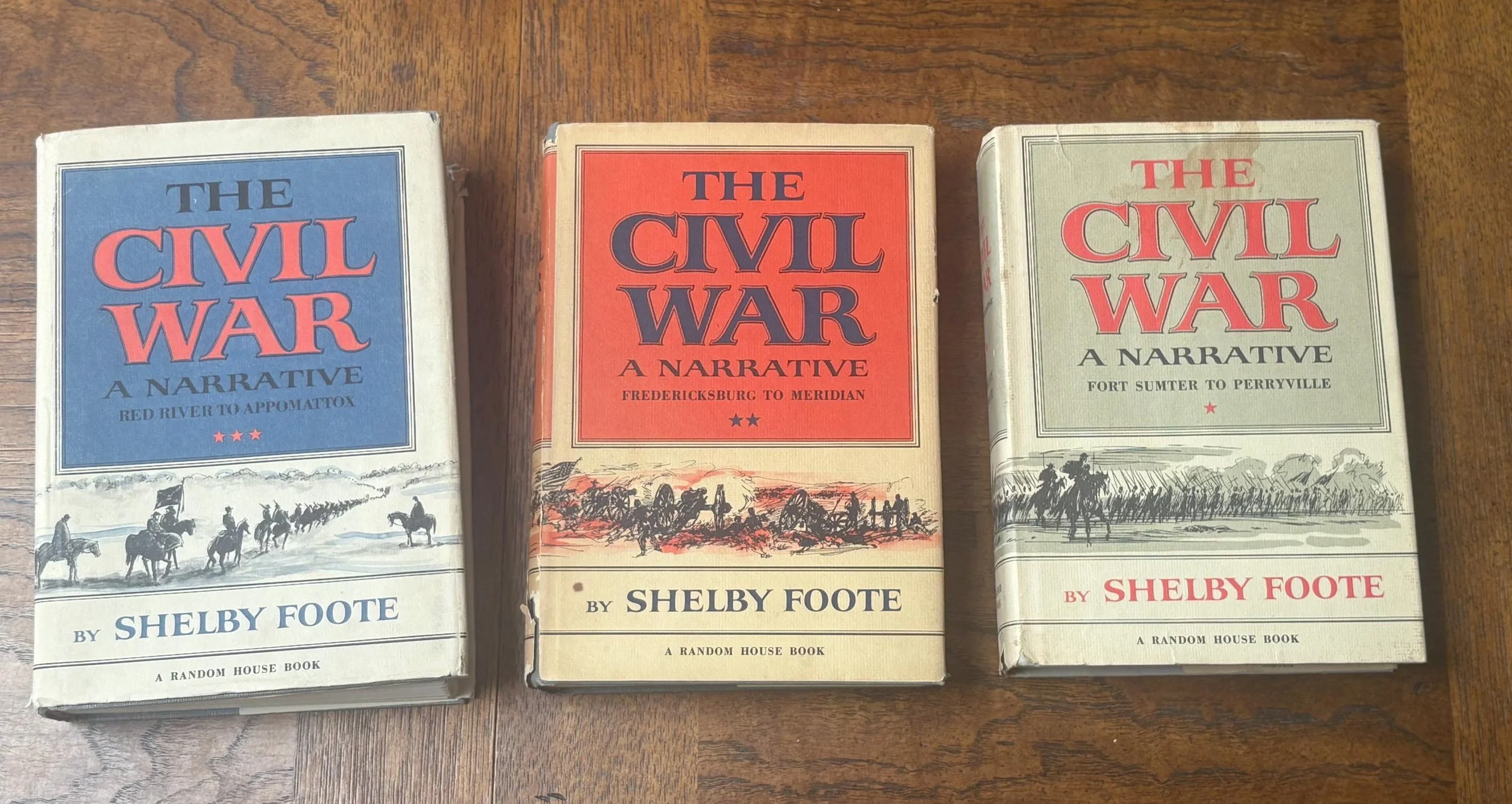
The Civil War: A Narrative — Complete Three-Volume Set
Shelby Foote’s monumental three-volume history is one of the most celebrated narrative accounts of the American Civil War. Written with the eye of a novelist and the devotion of a lifelong student of the conflict, the work carries the reader from the opening crisis at Fort Sumter to the final surrender at Appomattox. Foote presents the war as a vast human drama, filled with soldiers, generals, politicians, civilians, victories, defeats, tragedy, and consequence. Though not written as a heavily footnoted academic study, it remains one of the most influential and readable Civil War narratives ever produced.
The Civil War: A Narrative, Volume I — Fort Sumter to Perryville
The first volume of Shelby Foote’s narrative begins with the secession crisis and the opening shots at Fort Sumter, then follows the war through its early campaigns in both the Eastern and Western Theaters. Covering First Manassas, Shiloh, the Seven Days, Second Manassas, Antietam, Perryville, and many lesser-known operations, this volume introduces the reader to the commanders, armies, political pressures, and early hopes that shaped the conflict. It is an ideal starting point for readers who wish to experience the Civil War as an unfolding story.
The Civil War: A Narrative, Volume II — Fredericksburg to Meridian
The second volume covers some of the most dramatic and consequential events of the war, including Fredericksburg, Chancellorsville, Gettysburg, Vicksburg, Chickamauga, Chattanooga, and the continued struggle for control of the Western Theater. Foote shows how events in Virginia, Tennessee, Mississippi, and Georgia were deeply connected, presenting the war as a vast national struggle rather than a series of isolated battles. This volume is especially valuable for readers seeking to understand the middle years of the war, when both sides faced enormous military and political challenges.
The Civil War: A Narrative, Volume III — Red River to Appomattox
The final volume follows the war through its last and most exhausting campaigns. Foote covers Grant’s Overland Campaign against Lee, the battles of the Wilderness, Spotsylvania, Cold Harbor, Petersburg, Sherman’s Atlanta Campaign and March to the Sea, the Shenandoah Valley, Franklin and Nashville, Appomattox, and the assassination of Abraham Lincoln. This volume brings the immense narrative to its conclusion, showing the collapse of Confederate resistance and the terrible cost of four years of war.
Stars in Their Courses: The Gettysburg Campaign, June–July 1863
This stand-alone volume presents Shelby Foote’s account of the Gettysburg Campaign, drawn from his larger Civil War narrative. It follows Lee’s invasion of Pennsylvania, the movement of the armies, the three days of battle, and the aftermath of one of the most famous engagements in American history. For readers not yet ready to commit to the full trilogy, Stars in Their Courses offers an excellent introduction to Foote’s literary style and his treatment of command, contingency, battlefield action, and historical consequence.
The Beleaguered City: The Vicksburg Campaign, December 1862–July 1863
This separate volume presents Foote’s account of the Vicksburg Campaign, one of the decisive military operations of the Civil War. The book follows Ulysses S. Grant’s difficult campaign to capture the Confederate stronghold on the Mississippi River and explains why Vicksburg was so strategically important to the Union war effort. Foote combines military movement, political pressure, individual leadership, and the suffering of soldiers and civilians into a powerful account of one of the war’s great turning points.
Shiloh: A Novel
Shelby Foote’s Shiloh is a historical novel centered on the Battle of Shiloh, one of the first great and terrible battles of the Civil War. Told through the perspectives of multiple Union and Confederate participants, the novel gives readers a literary window into the confusion, courage, fear, and violence of battle. Though fictional, the work reflects Foote’s deep knowledge of the war and his lifelong interest in the men who fought it. It belongs in any Civil War library as an important example of serious historical fiction.
Chickamauga and Other Civil War Stories
This anthology, edited by Shelby Foote, brings together literary treatments of the Civil War from a variety of writers. Rather than serving as a traditional history, the collection explores how the war has been remembered, imagined, and interpreted through fiction. It is best placed in a section devoted to Civil War literature, historical fiction, or the memory of the war. For readers interested in the Civil War as both history and literary subject, this volume offers a valuable companion to Foote’s nonfiction narrative.
The Red Badge of Courage — Modern Library Edition with Introduction by Shelby Foote
Stephen Crane’s The Red Badge of Courage is one of the most famous Civil War novels ever written, and this edition is notable for including an introduction by Shelby Foote. Although Foote did not write the novel itself, his introduction helps situate Crane’s work within the broader literary and historical memory of the war. This edition is especially useful for readers interested in how later generations imagined the experience of Civil War combat, fear, courage, and personal transformation.
Featured Author: Allan Nevins
Ordeal of the Union — Complete Eight-Volume Set
Allan Nevins’s Ordeal of the Union is one of the most ambitious histories ever written on the coming of the Civil War and the war itself. Spanning eight volumes, the series traces the political, constitutional, economic, sectional, and military developments that carried the United States from the aftermath of the Mexican War through the surrender of the Confederate armies in 1865. For serious students of the Civil War era, Nevins remains an essential author.
Ordeal of the Union: Fruits of Manifest Destiny, 1847–1852
The opening volume begins in the aftermath of the Mexican War and examines the expansion of the United States, the acquisition of new western territories, and the mounting sectional tensions that followed. Nevins places the coming conflict within the broader world of American expansion, party politics, economic growth, and the unresolved question of slavery in the territories.
Ordeal of the Union: A House Dividing, 1852–1857
This second volume continues the story of the antebellum crisis through the mid-1850s. Nevins covers the deepening sectional division, the breakdown of old political alignments, the rise of new parties, the Kansas-Nebraska controversy, and the growing sense that the Union was becoming increasingly difficult to hold together. It is an important volume for understanding the political world that produced the Civil War.
The Emergence of Lincoln: Douglas, Buchanan, and Party Chaos, 1857–1859
The third volume focuses on the political chaos of the late 1850s, especially the collapse of older party structures and the rise of Abraham Lincoln as a national figure. Nevins gives significant attention to Stephen A. Douglas, James Buchanan, the Dred Scott decision, the Lincoln-Douglas debates, and the increasingly unstable political environment that preceded secession.
The Emergence of Lincoln: Prologue to Civil War, 1859–1861
This volume carries the reader from John Brown’s raid and the election of 1860 through the secession crisis and the opening of war. Nevins examines the decisions, miscalculations, constitutional arguments, political pressures, and sectional fears that brought the country to Fort Sumter. It is one of the most important volumes in the series for readers studying the immediate causes of the war.
The War for the Union: The Improvised War, 1861–1862
The first of Nevins’s war volumes examines the opening year of the conflict, when both Union and Confederate governments struggled to raise armies, organize command structures, develop strategy, and understand the scale of the war they had entered. Nevins presents 1861 and early 1862 as a period of improvisation, uncertainty, political pressure, and rapidly expanding military commitment.
The War for the Union: War Becomes Revolution, 1862–1863
This volume follows the war as it grew larger, harder, and more revolutionary in character. Nevins covers the major campaigns of 1862 and 1863 while also examining the transformation of Union war aims, the coming of emancipation, the strain on civilian society, and the deepening consequences of a conflict that neither side could easily end.
The War for the Union: The Organized War, 1863–1864
In this volume, Nevins turns to the maturing of the Union and Confederate war efforts. The armies, governments, supply systems, political leadership, and military strategies had become more organized and deliberate. Nevins examines the campaigns, command decisions, and home-front pressures of 1863–1864 as the war entered its most demanding phase.
The War for the Union: The Organized War to Victory, 1864–1865
The final volume brings Nevins’s great series to its conclusion. It covers the last year of the war, including Grant’s command, Sherman’s campaigns, the 1864 election, the fall of Atlanta, the struggle around Petersburg, the collapse of Confederate resistance, and Appomattox. Nevins’s final two volumes won the 1972 National Book Award in History.
The Statesmanship of the Civil War
This shorter work grew out of lectures Nevins delivered at the University of Virginia. Rather than offering a full battle narrative, it provides a concentrated analysis of the political leadership, issues, personalities, and decisions that shaped the Civil War. It is a useful companion to Ordeal of the Union for readers who want Nevins’s interpretation in a more concise form. The New Yorker described it in 1954 as a brief critical summary of Civil War issues and personalities.
Civil War Books: A Critical Bibliography
Edited by Allan Nevins, Bell Irvin Wiley, and James I. Robertson Jr., this two-volume bibliography is not a narrative history, but it is an important tool for serious Civil War study. It evaluates and organizes thousands of Civil War titles and helps readers understand the older landscape of Civil War scholarship. I would place this under a section such as Research Tools & Bibliographies rather than among the main narrative histories.
Featured Author: Bruce Catton
Mr. Lincoln’s Army
The first volume of Bruce Catton’s celebrated Army of the Potomac trilogy introduces the Union’s most famous army during the difficult early years of the war. Catton follows the army through its organization, early campaigns, internal struggles, and the leadership of George B. McClellan. Written with elegance and sympathy, the book captures the hopes, frustrations, courage, and confusion of the men who fought for the Union in the Eastern Theater.
Glory Road
The second volume of the Army of the Potomac trilogy carries the story through some of the war’s most dramatic campaigns, including Fredericksburg, Chancellorsville, and Gettysburg. Catton presents the Army of the Potomac as both a military organization and a human community, filled with ordinary soldiers, flawed commanders, political pressures, and repeated tests of endurance. This volume is especially valuable for readers interested in the army’s long road from defeat and frustration toward eventual confidence.
A Stillness at Appomattox
The final volume of Catton’s Army of the Potomac trilogy follows the army from the campaigns of 1864 through Petersburg and the final pursuit to Appomattox. It is one of Catton’s finest works, combining battlefield narrative, soldier experience, and the emotional weight of the war’s conclusion. The book captures the exhaustion, determination, sacrifice, and final triumph of the army that fought its way to the end of the conflict.
The Army of the Potomac Trilogy
This collected edition brings together Catton’s three classic volumes on the Army of the Potomac: Mr. Lincoln’s Army, Glory Road, and A Stillness at Appomattox. Together, they form one of the most beloved narrative histories of any Civil War army. For readers who want to follow the Union war effort in Virginia from its uncertain beginnings to its final victory, this trilogy remains essential reading.
Bruce Catton’s Civil War
This volume gathers Catton’s famous Army of the Potomac trilogy into a single Civil War reading experience. It is an excellent way to encounter Catton’s best-known work and his literary treatment of the soldiers, commanders, battles, and campaigns that shaped the Eastern Theater. For readers who appreciate vivid narrative history, this collection offers one of the classic introductions to Catton’s Civil War writing.
The Centennial History of the Civil War — Complete Set
Catton’s three-volume Centennial History of the Civil War was written during the centennial era and remains one of the finest broad narratives of the conflict. Unlike the Army of the Potomac trilogy, this series tells the story of the entire war, including politics, strategy, campaigns, leadership, home front pressures, and the collapse of the Confederacy. It is a superb companion to Shelby Foote for readers who want another major narrative history of the war.
The Coming Fury
The first volume of Catton’s Centennial History of the Civil War covers the road to war, the secession crisis, Fort Sumter, the mobilization of North and South, and the early months of conflict. Catton is especially strong in showing how political decisions, sectional fears, constitutional disputes, and military uncertainty gradually hardened into war. This is one of the best narrative introductions to the opening of the conflict.
Terrible Swift Sword
The second volume of the Centennial History follows the war through its expanding scope and increasing violence. Catton covers the major campaigns of 1862 and 1863, including the growing scale of the war, the transformation of Union strategy, and the deepening political and social consequences of the conflict. It is a strong middle-volume narrative that helps readers understand how the war became longer, harder, and more destructive than either side first expected.
Never Call Retreat
The final volume of the Centennial History of the Civil War carries the story from the later campaigns of the war to the surrender of the Confederate armies. Catton follows Grant, Lee, Sherman, Lincoln, Davis, and the exhausted armies and civilians who endured the final stages of the conflict. The book brings Catton’s broad Civil War narrative to a powerful close, emphasizing both the military defeat of the Confederacy and the immense human cost of the war.
This Hallowed Ground: The Story of the Union Side of the Civil War
This is Catton’s single-volume narrative of the Civil War from the Union perspective. It is concise, readable, and beautifully written, making it one of the best introductions to Catton for readers who may not yet be ready for a full trilogy. While focused on the Union side, the book is not merely a list of battles; it explores leadership, morale, politics, war aims, and the meaning of the conflict as understood by those who fought to preserve the Union.
The American Heritage Picture History of the Civil War
This richly illustrated volume combines Catton’s narrative skill with maps, photographs, drawings, paintings, and visual material from the Civil War era. It is an ideal book for readers who want to see the war as well as read about it. Though accessible to beginners, it remains valuable for anyone interested in the visual memory of the war and the way images shaped public understanding of the conflict.
The American Heritage Short History of the Civil War
This shorter treatment offers a compact introduction to the major events, leaders, campaigns, and consequences of the Civil War. It is especially useful for new readers, students, and those who want Catton’s narrative voice in a more concise form. The book works well as an entry point before moving into Catton’s larger trilogies.
The Civil War
This edition presents Catton’s Civil War narrative in a compact and accessible format, often associated with the text of his American Heritage history. It is useful for readers who want a readable overview without committing to the full Centennial History or Army of the Potomac trilogies. As with much of Catton’s writing, its strength lies in clarity, pacing, and a deep sense of the war’s human drama.
U. S. Grant and the American Military Tradition
This short study examines Ulysses S. Grant as a military figure and as part of the broader American military tradition. Catton presents Grant not merely as a battlefield commander, but as a man whose style of leadership reflected larger American traits: practicality, persistence, flexibility, and determination. It is a useful companion to Catton’s larger Grant works.
Grant Moves South
This volume continues the Grant biography begun by Lloyd Lewis and follows Grant’s rise during the Western campaigns. Catton traces Grant’s emergence from relative obscurity to national importance through operations such as Fort Donelson, Shiloh, and the movement toward Vicksburg. It is one of the best narrative treatments of Grant’s early military development and his growing importance to the Union war effort.
Grant Takes Command
The final volume in the Grant biography series follows Grant from his triumphs in the West to supreme command of all Union armies. Catton examines Grant’s leadership during the final phase of the war, including his relationship with Lincoln, his strategy against Lee, the Overland Campaign, Petersburg, and Appomattox. This is an essential work for readers seeking to understand Grant’s role in bringing the war to a close.
Two Roads to Sumter
Written with William Catton, this book examines the road to the Civil War through the lives and careers of two central figures: Abraham Lincoln and Jefferson Davis. By following both men toward the crisis of 1860–1861, the book presents the coming of the war as a collision of political convictions, regional loyalties, constitutional arguments, and personal histories. It is a strong choice for readers interested in leadership and the secession crisis.
America Goes to War: The Civil War and Its Meaning in American Culture
This work reflects on the broader meaning of the Civil War in American life and memory. Rather than serving only as a battle narrative, it considers what the war revealed about American society, national identity, democratic government, and the character of the people who fought it. It is especially useful for readers interested in how the Civil War shaped American historical consciousness.
Gettysburg: The Final Fury
Catton’s account of Gettysburg offers a concise and dramatic treatment of the war’s most famous battle. It is an accessible introduction to the campaign, the three days of fighting, and the meaning of Gettysburg in Civil War memory. This is a good choice for readers who want a shorter Gettysburg study written in Catton’s distinctive style.
Banners at Shenandoah: A Story of Sheridan’s Fighting Cavalry
This historical novel for younger readers follows the drama of the Shenandoah Valley campaign and Sheridan’s cavalry. Though fictionalized, it reflects Catton’s deep knowledge of Civil War military history and his ability to make the war vivid for a broad audience. It belongs in a section devoted to Civil War literature, youth reading, or historical fiction.
Names from the War
This shorter Catton work reflects his lifelong fascination with the people, places, and memories of the Civil War. It is best treated as a reflective or literary work rather than a standard campaign history. For readers who appreciate Catton’s prose and his ability to evoke the emotional landscape of the war, this title offers a more meditative companion to his larger histories.
Reflections on the Civil War
This later collection presents Catton’s reflections on the war, its leaders, its soldiers, and its meaning in American history. It is especially valuable for readers who want to understand Catton’s mature interpretation of the conflict and his broader view of why the Civil War continued to matter long after the guns fell silent. This is a strong companion volume for those who have already read his major narratives.
Shiloh
Catton’s treatment of Shiloh introduces readers to one of the first great shocks of the Civil War. The battle revealed that the conflict would be far bloodier and more demanding than many had imagined. This title is useful for readers seeking a focused account of the Western Theater and the emergence of Ulysses S. Grant as a major figure in the war.
Missionary Ridge
This work focuses on the dramatic fighting around Chattanooga, especially the Union assault on Missionary Ridge. The battle helped open the way into Georgia and set the stage for later operations against Atlanta. Catton’s account is useful for readers interested in the Western Theater and the strategic importance of Chattanooga in the later course of the war.
Bruce Catton’s America: Selections from His Greatest Works
This collection gathers selections from Catton’s broader body of writing, including his reflections on American history, war, democracy, and national memory. It is not exclusively a Civil War book, but it belongs in a Catton section because the Civil War was central to his historical imagination. This is best placed under “Selections and Collections” rather than under the main Civil War narrative works.
Featured Author: E. B. Long
The Civil War Day by Day: An Almanac, 1861–1865
E. B. Long’s The Civil War Day by Day is one of the most useful chronological reference works ever produced on the American Civil War. Written with Barbara Long, the book follows the conflict day by day from 1861 through 1865, recording battles, skirmishes, troop movements, naval operations, political developments, government actions, and other significant events as they unfolded. For students, writers, educators, reenactors, researchers, and anyone studying the war chronologically, this volume is an indispensable companion to the Official Records and other primary sources. Major Civil War bibliographies continue to list it as a standard reference work.
The Saints and the Union: Utah Territory During the Civil War
This specialized study examines the Utah Territory during the Civil War, a subject often overlooked in broader histories of the conflict. Long explores the relationship between the federal government, the Union war effort, Brigham Young, the Latter-day Saints, territorial politics, military occupation, and the complicated position of Utah during the national crisis. Although Utah was far from the main battlefronts, the territory played an important role in federal military planning, western communications, Indian affairs, and the broader challenge of preserving Union authority during the war. This is an excellent regional work for readers interested in the Civil War beyond the Eastern and Western battlefields.
As Luck Would Have It — Otto Eisenschiml and E. B. Long
Written with Otto Eisenschiml, As Luck Would Have It is a Civil War study focused on chance, accident, timing, and coincidence. Rather than offering a full chronological history of the war, the book examines episodes in which unexpected circumstances helped shape important events. A contemporary notice described it as a Civil War work built around fifteen wartime episodes affected by sheer hazard, including events connected with Lee’s surrender, Lincoln’s assassination, and Anglo-American tensions during the war. This would fit well in a section on Civil War Interpretation, Anecdotes, and Historical Curiosities.
The Civil War — Otto Eisenschiml, Ralph Newman, and E. B. Long
This collaborative mid-twentieth-century Civil War volume was produced by Otto Eisenschiml, Ralph Newman, and E. B. Long. Because Long is credited as one of the collaborators, it belongs in an E. B. Long section, though it should probably be treated as a supplementary work rather than his principal contribution. For the National Civil War Institute, I would place this under Classic Civil War Surveys & Older Interpretive Works.
A Basic Civil War Library — Ralph G. Newman and E. B. Long
Written with Ralph G. Newman, A Basic Civil War Library is not a narrative history, but a bibliographical guide to important Civil War literature. It belongs under Research Tools & Bibliographies rather than general histories. For your Institute, this is actually very useful, because it shows how earlier Civil War scholars and booksellers thought about the essential works of the field. A bibliographical tool like this fits beautifully on a recommended reading page devoted to serious study.